Commercial & Architectural Solar Bollard & Pillar Lights
Engineered for pathways, landscaped public spaces, commercial complexes, and hospitality estates—delivering low-glare, ambient pedestrian illumination with zero utility trenching.
Purpose-Built for Pathway Safety & Seamless Architectural Integration
Commercial-grade off-grid solar bollards and pillar lights featuring rugged die-cast aluminum, 360-degree optical diffusers, and long-life LiFePO4 energy storage—built for reliable human-scale outdoor lighting.
Zero-Trenching Surface & Plinth Mount
IP65/IK08 Die-Cast Aluminum (ADC12)
360-Degree Low-Glare Optical Diffusion
High-Efficiency Monocrystalline PV & LiFePO4
Smart Dusk-to-Dawn & Motion Sensors
Pedestrian Safety & Architectural Aesthetics
Lumin Solar Solutions designs high-efficacy commercial-grade solar bollard and mini pillar lights engineered for pathways, plazas, courtyards, and perimeter walkways across diverse commercial application scenarios. Built with architectural die-cast aluminum (ADC12), UV-stabilized PC diffusers, and weather-sealed IP65/IP67 housings, our Cyrus series and commercial bollards eliminate costly underground trenching and utility wiring fees. Equipped with monocrystalline solar panels, Grade-A LiFePO4 battery storage, and dual CCT ambient options, they pair perfectly with our Solar Garden & Pathway Lights to deliver uniform 360-degree ground illumination and visual comfort. For custom height specifications or photometrics, contact our team via Engineering Support.
No matching results found
Product categories
Commercial Solar Bollard & Pillar Light Models
Browse our vandal-resistant solar bollards engineered for pedestrian pathways, plazas, and 360-degree ambient landscape illumination.
Showing all 4 results
Built for low-level pathway guidance and architectural aesthetics — engineered for hospitality estates, public plazas, commercial walkways, garden perimeters, and residential landscapes.
How to Select the Right Commercial Solar Bollard & Pillar Light
Key engineering criteria evaluating 360-degree low-glare optical distribution, IP65/IK08 vandal-resistant housings, LiFePO4 battery autonomy, and secure plinth mounting for pedestrian pathways.

Height & Physical Scale
Choose compact mini pillars (200mm to 400mm) for low-level flower beds and residential borders, or tall architectural bollards (800mm to 1000mm) for commercial walkways and public plazas.
Optical Distribution & Glare Control
Select 360-degree downward reflectors or frosted prismatic PC diffusers to project uniform ground-level light while preventing eye glare for pedestrians and drivers.
Solar Panel Array & Exposure
Ensure top-mounted monocrystalline PV panels receive direct sun access without tree canopy or building overhang shadows to maintain daily 100% battery recharge.
Battery Chemistry & Autonomy
Specify long-life LiFePO4 battery packs rated for over 2,000 charge cycles that guarantee 3 to 5 consecutive nights of continuous operation during overcast weather.
Material Quality & Ingress Rating
Look for heavy-duty die-cast aluminum housings with IP65 weather sealing and IK08 impact resistance to withstand harsh rain, snow, salt spray, and physical impacts.
Lighting Control & Color Temperature
Utilize dual CCT (3000K warm white and 6000K cool white) options and smart motion sensors to automatically balance ambient mood lighting with full safety illumination.
Applications & Scenarios
Versatile, human-scale solar bollard and pillar luminaires designed to deliver low-glare, 360-degree ambient and pathway illumination across commercial complexes, public parks, residential estates, and hospitality walkways with zero grid power.

Commercial Walkways & Pedestrian Corridors
Provides uniform, low-glare ground-level illuminance (10 to 30 lux) along paved walkways, pedestrian corridors, and outdoor retail plazas. Integrated 360-degree optical diffusers eliminate harsh visual glare for safe nighttime foot traffic.

Garden Pavilions, Park Paths & Public Plazas
Delivers reliable dusk-to-dawn accent lighting around garden pavilions, pergolas, municipal park paths, and community plazas. High-capacity LiFePO4 energy storage ensures 3 to 5 consecutive nights of autonomous operation during overcast weather.

Courtyards, Patios & Hospitality Terraces
Enhances nighttime architectural aesthetics across private courtyards, patio areas, dining terraces, and luxury resort walkways. Features dual CCT warm ambient options (3000K/4000K) wrapped in corrosion-resistant die-cast aluminum.

Perimeter Fences, Gates & Pillar Tops
Engineered for surface-mount plinth installation on concrete piers, masonry fence posts, entryway columns, and boundary walls. Heavy-duty mounting flanges securely anchor with expansion bolts rated for wind resistance up to 140 km/h.

Flower Beds, Garden Edges & Landscape Borders
Compact mini solar pillars illuminate low-level flower beds, garden edges, pathway borders, and planter boxes without obstructing architectural sightlines. Fully sealed IP65 housings resist rain, dust, and coastal salt spray.

Corporate Campuses & Facility Perimeters
Improves nighttime facility safety and campus navigation around commercial office complexes, parking access paths, and facility perimeters with zero electricity costs and zero underground conduit trenching.
Skip the Trenching. Eliminate Energy Bills.
Calculate your 5-year project ROI below and see how much your facility can save with Lumin Solar Solutions.
Private Project ROI Calculator
💡 Pro Tip: Switching to solar allows you to eliminate trenching costs and expensive cabling.
Estimated Annual Energy Savings:
$0.00*Based on replacing 150W traditional lamps running 12hrs/day.
Traditional Grid vs. Lumin Solar Lighting Solutions Cost Analysis
| Project Cost Items (30 Units) | Traditional Grid | Lumin Solar Solutions |
|---|---|---|
| Trenching & Labor | $3,000 - $8,000 | $0 (No Digging) |
| Cabling & Wiring | $2,500 - $5,000 | $0 |
| Transformer/Switchgear | Essential Infrastructure Cost | Not Needed |
| Electricity Bill (Annual) | $1,500 - $2,500 | $0 (Free) |
| Installation Time | 7-14 Days | 1-2 Days |
| Total Hidden Costs | EXTREMELY HIGH | ZERO |
*Calculated based on average private industrial projects. Lumin Solar Solutions eliminates infrastructure overhead.
Why pay for copper wires and manual labor when you can invest that budget into high-quality solar technology?
Your Assurance of Quality & Safety
Internationally Recognized Certifications
Our Credentials Ensure Your Peace of Mind:
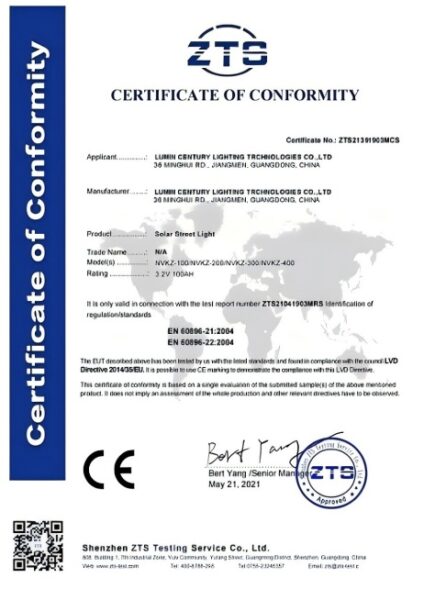
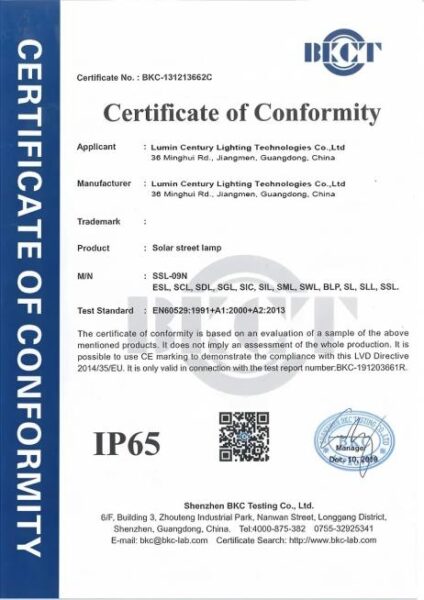
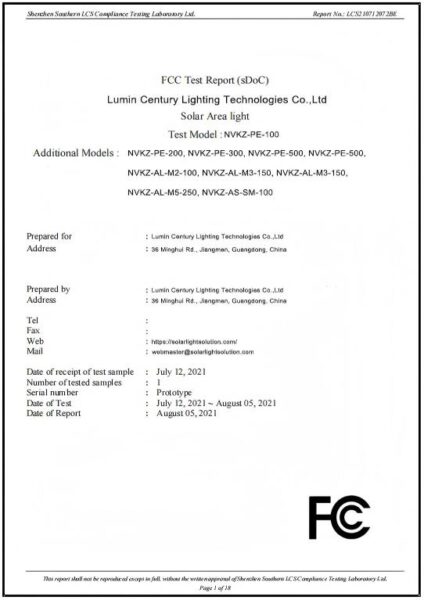
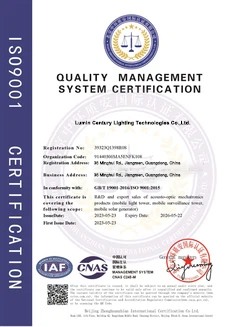
We are ISO 9001 certified for quality management. Our products hold major international certifications including CE, RoHS, ETL, and IEC, and are designed to meet region-specific standards. This means proven performance and seamless acceptance, whether your project is in a mature or developing market.


Our Commitment to Reliability
Inside the Factory: Testing & Validation
Our commitment is rooted in our vertically integrated 5,000㎡ modern factory and advanced in-house R&D Laboratory. Here, we validate every product through tests like IP67/68 submersible testing, EMC immunity checks, and extreme temperature cycling.

Solar Panel IV Curve Test
Automated IV curve tracing under Standard Test Conditions (STC) per IEC 61215 and IEC 61730 standards. We rigorously verify peak power output, fill factor, and electrical efficiency to guarantee a positive power tolerance (+3%) on all PV modules.

Automated Dispensing
High-precision CNC robotic dispensing for polyurethane and silicone sealant application across luminaire housings and optical lenses. Ensures seamless IP66/IP67 ingress protection and long-term weatherproofing in extreme outdoor environments.
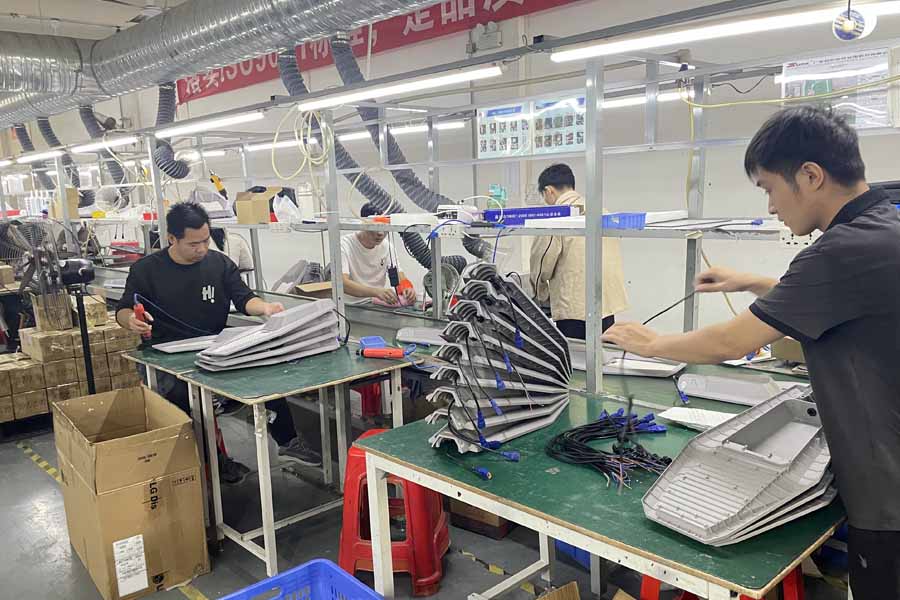
Assembly Line
ISO 9001-certified standardized assembly with strict ESD anti-static controls and lean workflow. Every finished solar fixture undergoes 100% full-load aging and burn-in testing prior to packaging to ensure batch-to-batch consistency for municipal tenders.

IP65/66 Water Jet Test
Rigorous ingress protection testing inside IEC 60529-compliant spray test chambers. We subject outdoor solar luminaires to continuous high-pressure water jets and dust exposure, validating official IP65, IP66, and IK10 impact resistance ratings.

Photometric & Colorimetric Test
Optical and electrical performance analysis using high-precision integrating spheres and spectroradiometers compliant with LM-79 and LM-80 standards. We measure lumen output, CCT, and CRI, generating official IES files for DIALux lighting simulations

Battery Protection Test
Comprehensive safety and reliability testing for LiFePO4 battery packs and smart BMS controllers under UN38.3 and IEC 62133 standards. Simulates extreme overcharge, over-discharge, and thermal cycling to guarantee 2,000+ deep-cycle lifespan.
Illuminating Success Stories Worldwide
See Our Products Powering Projects Globally


Community Safety Lighting: NV Series Street Lights for S2 Heights Village Roads

Thailand Farm Solar Lighting: Waterfront Illumination with “Moon in Water” Garden Lights
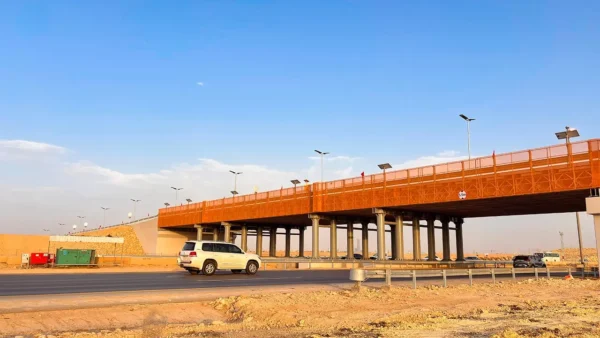
High-Temperature Municipal Street Lighting Project, Dubai
Illuminating the New Port of Ndayane: A Landmark Solar Lighting Project, Senegal

Coastal Illumination Upgrade: Solar Flood Lighting for Australian Seaside Accommodation
Frequently Asked Questions (FAQ)
What critical technical specifications should engineers evaluate when selecting commercial solar bollard and pillar lights?
Evaluating commercial solar bollard and pillar lights requires verifying photovoltaic conversion efficiency, battery chemistry, luminaire housing material, optical glare control, and ingress protection to guarantee long-term outdoor performance.
Photovoltaic & Battery Array: Specify monocrystalline PV panels with conversion efficiency exceeding 21% paired with Lithium Iron Phosphate (LiFePO4) batteries rated for over 2,000 to 3,000 charge cycles.
Housing Material & Ingress: Look for heavy-duty ADC12 die-cast aluminum construction featuring architectural powder coating, IP65 or IP67 ingress sealing, and IK08 impact resistance.
Optical Distribution: Choose 360-degree downward optical diffusers or frosted prismatic reflectors providing warm 3000K to 4000K CCT to ensure pedestrian visual comfort without glare.
Mechanical Mounting: Ensure structured pedestal bases with pre-drilled mounting flanges suitable for expansion bolts or anchor J-bolts on concrete plinths and stone pillars.
How do commercial solar bollard and pillar lights maintain reliable illumination during consecutive overcast or rainy days?
Commercial solar bollard and pillar luminaires achieve continuous multi-night autonomy through oversized LiFePO4 battery capacity, high-efficiency monocrystalline solar panels, and intelligent power management algorithms that regulate output based on battery state-of-charge.
Battery Autonomy Sizing: High-capacity Grade-A LiFePO4 battery packs are engineered to store sufficient energy for 3 to 5 consecutive nights of continuous dusk-to-dawn operation without direct sunlight.
Intelligent Power Management: Smart microcontrollers automatically adjust LED current or switch to motion-activated dimming profiles when battery voltage drops during extended cloudy periods.
High Conversion Photovoltaics: Top-mounted monocrystalline PV arrays harvest ambient solar irradiation even under diffused light conditions to maintain daily partial recharging.
Thermal & Battery Protection: Integrated battery management systems (BMS) protect cells against overcharge, deep discharge, and extreme operational temperatures ranging from -10 degrees C to 60 degrees C.
What are the standard installation methods and foundation requirements for commercial solar bollard and pillar luminaires?
Commercial solar bollards and pillar lights are surface-mounted onto concrete plinth foundations, masonry wall tops, or deck post caps using expansion anchor bolts, eliminating all underground electrical conduit and trenching.
Concrete Plinth Anchoring: Free-standing bollards along pathways are secured onto raised concrete foundations using stainless steel expansion bolts or embedded J-bolt anchor cages via heavy-duty base flanges.
Pillar & Wall Cap Surface Mount: Compact mini solar pillars attach directly to stone masonry gate columns, brick fence caps, or wooden balustrade post tops with flush surface fasteners.
Zero-Trenching Advantage: Off-grid solar operation removes the need for high-voltage AC wiring, ground excavation, utility transformer connections, and main breaker panel upgrades.
Site Exposure Criteria: Luminaires must be positioned in open hardscape areas where top monocrystalline PV panels receive unobstructed sunlight without canopy or building overhang shading.
How do engineers calculate spacing and beam distribution for solar bollards along pedestrian walkways and perimeter paths?
Pathway lighting design requires balancing fixture mounting height, beam spread, and foot-candle requirements to achieve uniform 10 to 30 lux ground illuminance without visual dark spots or eye glare.
Recommended Fixture Spacing: Commercial bollards (800mm to 1000mm height) are typically spaced 3 to 6 meters apart depending on required pathway light levels and optical distribution.
360-Degree Downward Optics: Precision reflectors direct luminous flux downward and outward, projecting a uniform circular pool of light while preventing light pollution and eye glare.
Mini Pillar Placement: Compact solar pillars (200mm to 400mm height) placed on retaining wall curbs or garden borders provide accent lighting with 1.5 to 3-meter spacing.
Photometric Uniformity: Uniformity ratios (Emax to Emin) under 3:1 along pedestrian walkways ensure safe foot traffic, hazard visibility, and architectural perimeter security.
What IP and IK rating standards are required for heavy-duty commercial solar bollards in outdoor public and coastal environments?
Heavy-duty solar bollards in public spaces and coastal facilities require an IP65 or IP67 ingress rating combined with IK08 or IK10 impact protection to withstand severe weather, dust, and physical impact.
Ingress Protection (IP65/IP67): Sealed silicone gasketing prevents dust ingress and protects internal electronics and optical chambers against low to high-pressure water jets and heavy rain.
Impact Resistance (IK08/IK10): Rugged ADC12 die-cast aluminum bodies and polycarbonate (PC) optical lenses resist vandalism, physical impacts, and accidental equipment collisions up to 5 to 20 Joules.
Corrosion Resistance: Marine-grade architectural powder coatings protect aluminum housings against salt spray, high humidity, UV degradation, and chemical exposure in coastal environments.
Thermal Weatherization: Weather-sealed optical and battery compartments prevent moisture condensation while maintaining heat dissipation for LED drivers and solar controllers.
How do commercial solar bollards and pillar lights compare to traditional AC grid-tied bollards in total cost of ownership (TCO) and ROI?
Commercial solar bollard and pillar luminaires deliver significantly lower total cost of ownership compared to traditional AC grid-tied lighting by eliminating trenching labor, electrical cabling, utility permits, and ongoing electricity costs.
Zero Trenching & Wiring Savings: Eliminating underground conduit, copper cabling, trenching labor, and asphalt repaving reduces upfront capital expenditure by 40% to 60% per project site.
Zero Operating Costs: Off-grid solar power operates with zero electrical utility expense throughout its 5 to 10-year design lifespan.
Rapid ROI Payback: Capital expenditure payback is typically achieved within 12 to 18 months through saved installation labor, zero power bills, and reduced maintenance.
Low Maintenance Lifespan: Long-life LED light sources (50,000+ hours) and maintenance-free LiFePO4 batteries (2,000+ cycles) minimize operational labor over multi-year commercial deployment.
Can't Find What You're Looking For?
We specialize in custom solar lighting solutions. Our experts will analyze your needs and provide a tailored proposal.