Proper planning and engineering design are critical to the long-term success, structural stability, and operational reliability of commercial and municipal off-grid solar lighting infrastructure. Unlike residential setups, large-scale public and industrial projects require rigorous mathematical modeling, environmental analysis, and precise component matching to ensure 10+ years of maintenance-free performance.
This comprehensive technical guide outlines the core engineering framework—derived from professional deployment standards and catalog specifications—for planning, sizing, and architecting off-grid solar street and area lighting systems.
Evaluating Site-Specific Environmental and Meteorological Parameters
The foundation of any robust solar lighting design begins with an accurate assessment of local environmental and climatic conditions. Failing to account for regional microclimates can lead to premature battery degradation or system failure during extended overcast periods.
- Core Meteorological & Site Inputs:
- Peak Sun Hours (PSH): Design calculations must rely on worst-case seasonal PSH matrices rather than annual averages. Lower PSH values in winter months dictate the minimum photovoltaic (PV) generation capacity required.
- Load Profile & Duty Cycle Mapping: Defining nightly operating duration, initial high-lumen lighting windows, and automated dimming stages.
- Autonomy Factor: Establishing strict weather contingency margins (3 to 5 days for standard commercial zones; 5 to 7 days for critical municipal corridors).
- Wind Load and Structural Factors: Structural designs must comply with regional wind-speed ratings, utilizing heavy-duty hot-dip galvanized Q235 steel poles and wind-tunnel-tested luminaire housings to withstand high-velocity winds and coastal typhoons.
System Architecture Selection: All-in-One vs. Split-Type
Choosing the correct system architecture depends on the roadway classification, required power capacity, and site installation constraints.
| Architectural Metric |
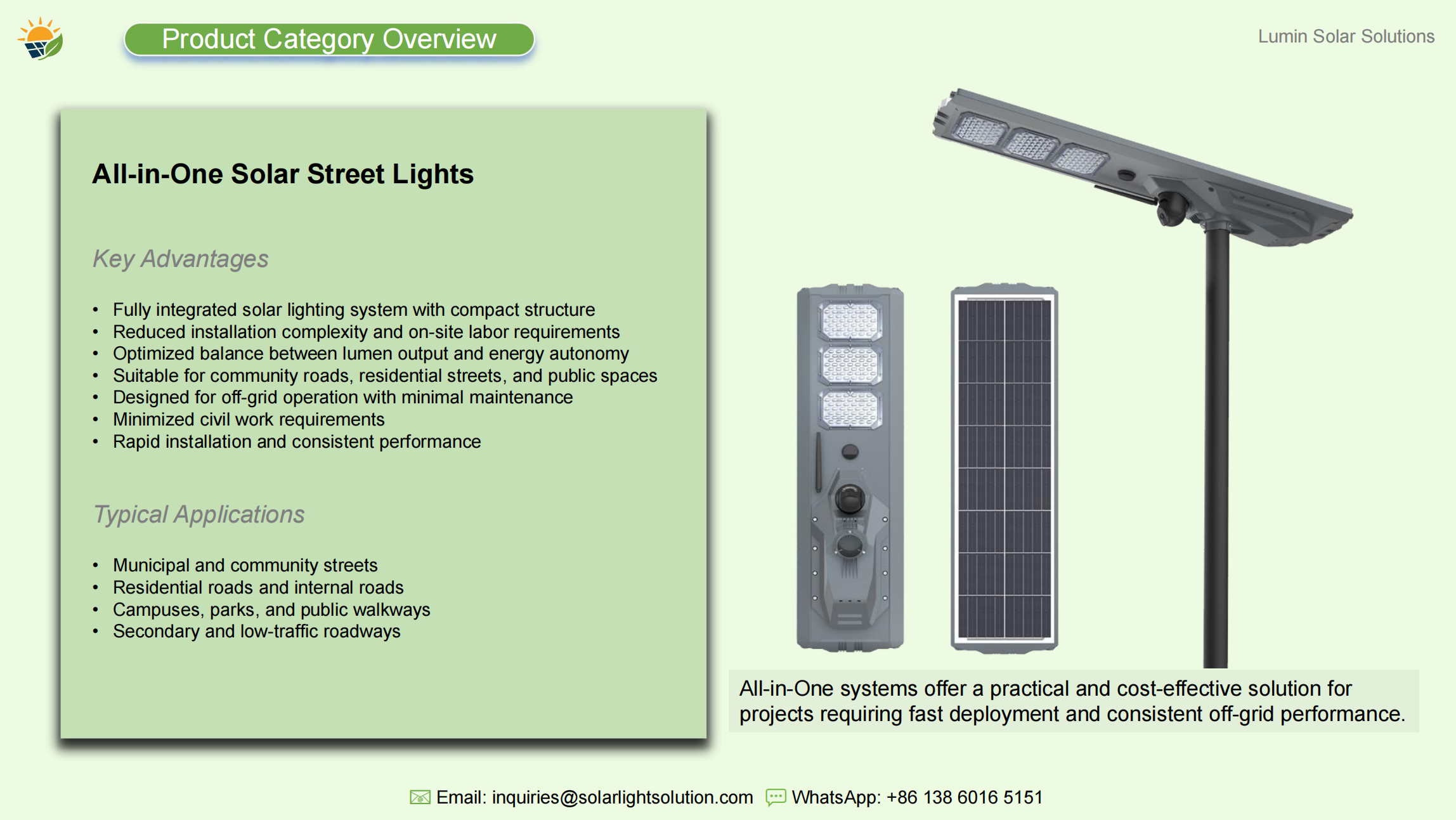
All-in-One Solar Street Lights |
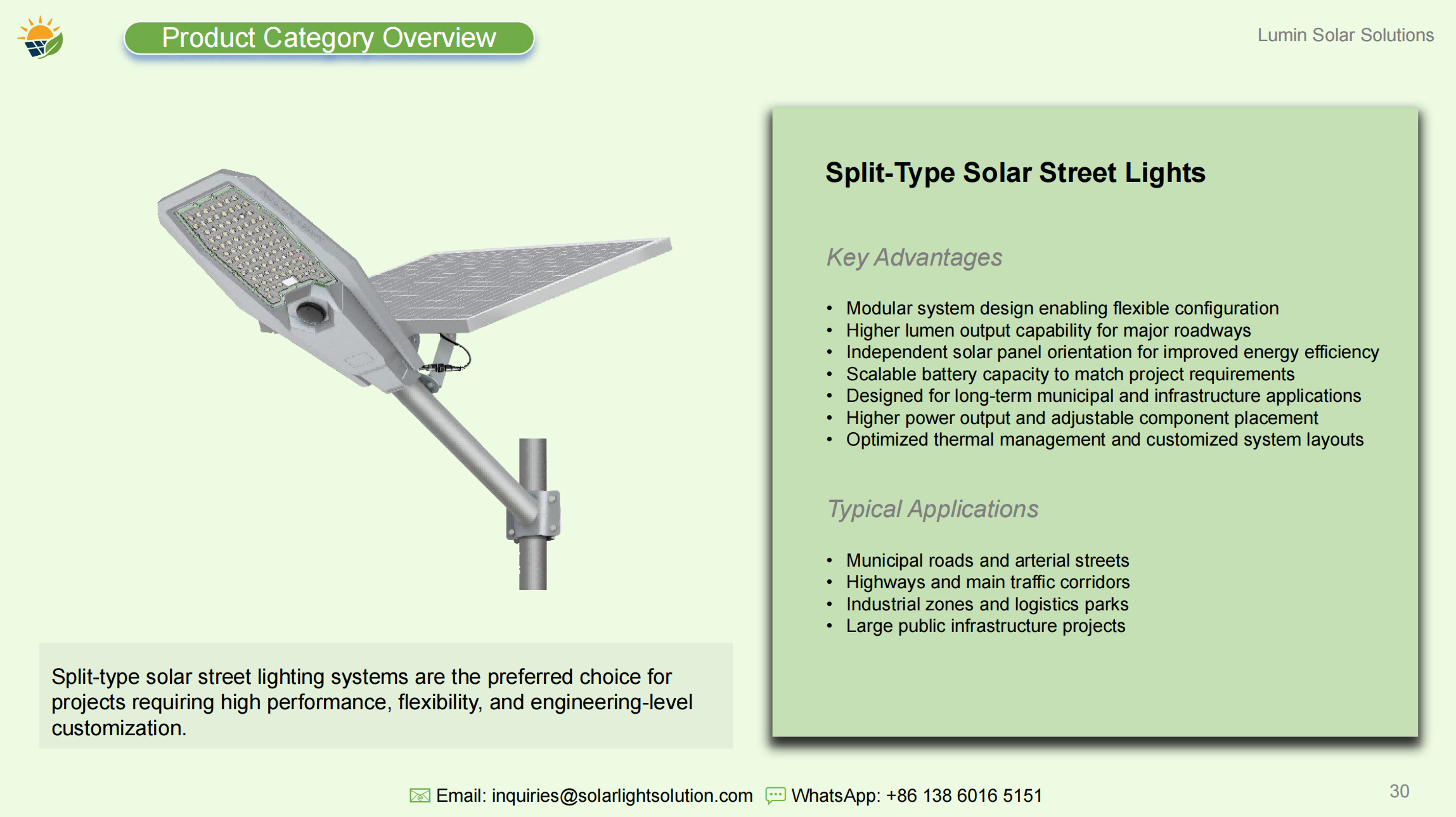
Split-Type Solar Street Lights |
| System Architecture |
Integrated panel, battery, controller, and luminaire housed in a single compact unit. |
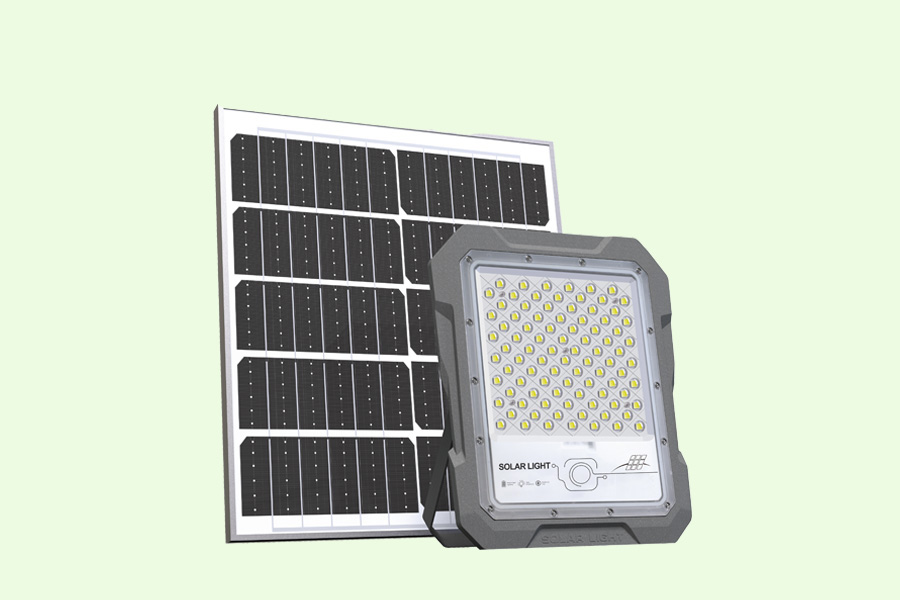
Modular design with separate solar panels, independent battery enclosures, and fixtures. |
| Power Scalability |
Standardized capacity; optimized for low-to-medium power requirements. |
High scalability; supports large solar panels and heavy-duty battery banks for high-power demands. |
| Installation Complexity |
Rapid plug-and-play deployment; minimal wiring and quick site execution. |
Requires professional pole assembly, bracket alignment, and secure cable management. |
| Orientation Flexibility |
Fixed angle determined by the luminaire or integrated bracket orientation. |
Highly flexible; solar panels can be independently angled toward optimal solar azimuth. |
| Ideal Project Scenarios |
Urban pathways, residential communities, rural roads, and rapid-deployment projects. |
Multi-lane municipal highways, industrial perimeters, high-security zones, and heavy-duty applications. |
Sizing Photovoltaic Panels and Industrial LiFePO4 Battery Storage
Balancing solar panel output with energy storage capacity prevents overcharging or deep-discharge cycling, both of which shorten component lifespans.
- High-Efficiency Monocrystalline Panels: Modern commercial systems utilize Grade-A monocrystalline or bifacial PV modules with energy conversion efficiencies exceeding 21% to 23%, ensuring rapid recharging even under diffused low-light conditions.
- LiFePO4 (Lithium Iron Phosphate) Battery Systems: Industrial-grade installations mandate LiFePO4 chemistry due to its superior thermal stability, safety profile, and deep-cycle performance. Quality commercial batteries deliver 2,000 to 3,500 cycles at 80% Depth of Discharge (DoD), translating to a dependable operational lifespan of 5 to 8 years before replacement.
- PV-to-Battery Ratio: Ensuring photovoltaic array peak power adequately replenishes the LiFePO4 battery bank within limited daylight windows while maintaining multi-day backup reserves.
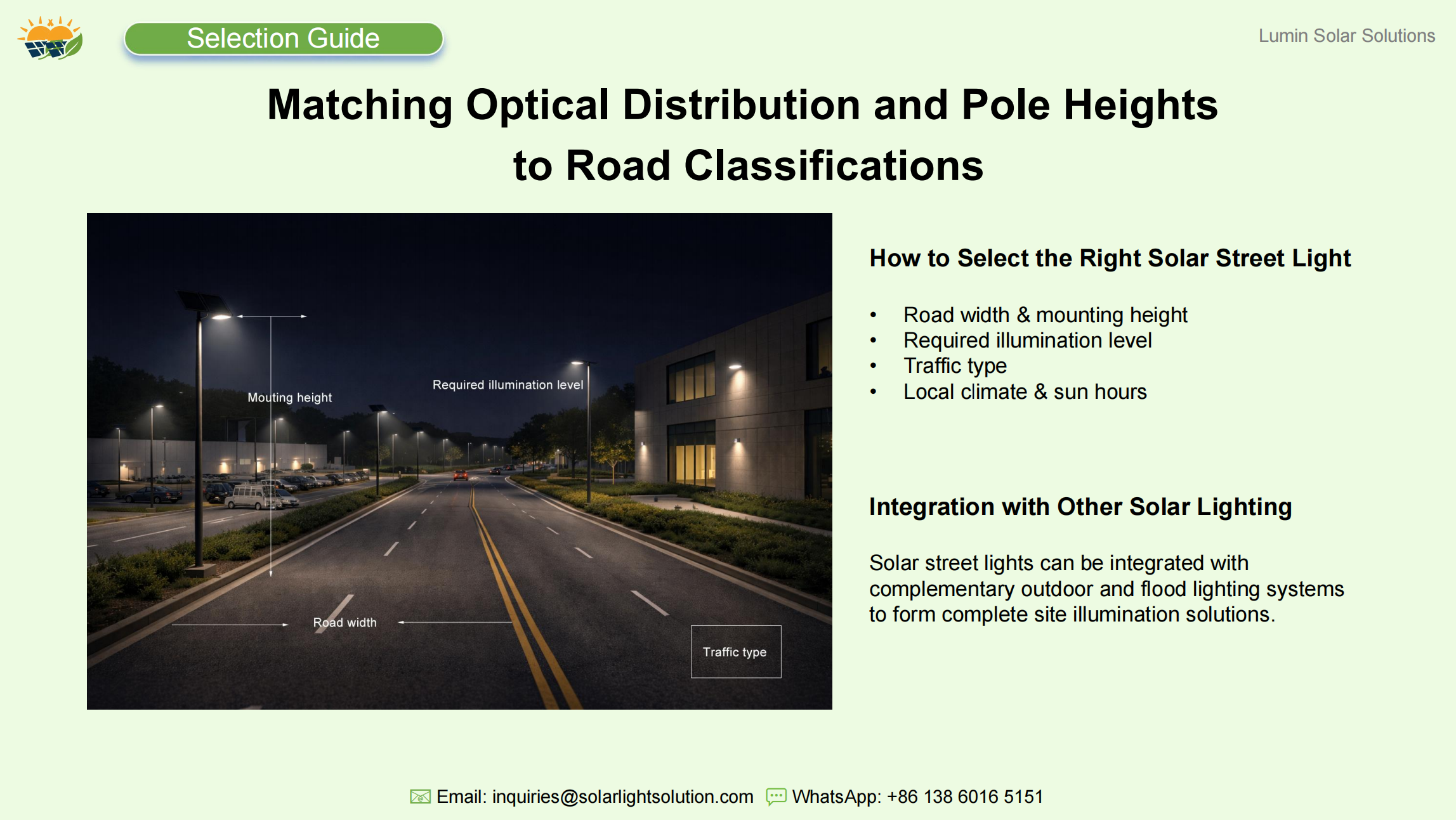
Matching Optical Distribution and Pole Heights to Road Classifications
Different urban and rural road layouts demand specific optical distribution curves (such as Type II, Type III, or Type V) and mounting heights to achieve uniform light distribution without dark spots or glare.
| Road Classification / Application |
Typical Road Width |
Recommended Pole Height |
Optical & System Recommendation |
| Highways & Arterial Roads |
12m – 20m+ (Multi-lane) |
9m – 12m |
High-lumen split-type systems with wide-angle roadway optics for strict luminance uniformity. |
| Municipal Streets & Urban Roads |
8m – 12m (2–4 lanes) |
7m – 9m |
High-output All-in-One or split systems designed for standard urban spacing. |
| Industrial Parks & Logistics Zones |
10m – 15m (Heavy traffic) |
8m – 12m |
Robust split-type systems engineered for extended operating hours and high-vibration zones. |
| Residential Communities & Campuses |
4m – 8m (Narrow roads) |
5m – 7m |
Human-scale All-in-One solar street or pathway lights prioritizing visual comfort and anti-glare. |
Smart Controls, Protection & Environmental Hardening
To ensure stable operation in volatile field conditions, municipal-grade solar lighting requires advanced firmware control and physical protection mechanisms.
- Intelligent Lighting Control Logic:
- Dynamic Power Scheduling: Multi-stage programmable time controls (e.g., 100% output for initial traffic peaks, shifting to 30%–50% energy-saving dimming via radar or motion sensors for remaining hours).
- Low-Voltage Protection Cutoff: Automated firmware safeguards preventing deep cell damage during extended low-sunlight anomalies.
- Mechanical & Environmental Hardening:
- IP68 Waterproof Enclosures: Sealed electronic compartments protecting internal charge controllers and battery modules against extreme humidity, dust storms, and heavy rainfall.
- Thermal Dissipation Architecture: Engineered aluminum housing designs preventing thermal degradation of LED modules and maintaining high luminous efficacy in high-heat desert climates.
- Anti-Vandalism & Security Measures: Internalized battery compartments within robust pole structures and tamper-resistant stainless steel fasteners to protect critical assets in public corridors.
Summary and Professional Engineering Support
Designing reliable off-grid municipal lighting requires careful harmonization of geographic solar data, electrical load profiles, and mechanical durability. By adhering to rigorous pre-engineering protocols, project developers can eliminate grid dependency, minimize lifetime operational expenditures (TCO), and ensure long-term infrastructure stability.
As an established direct source manufacturer with 17 years of production expertise and 1,000+ successful deployments across 42+ countries,
Lumin Solar Solutions provides comprehensive engineering support, DIALux simulation guides, and custom project-level calculations. Visit our
OEM/ODM Customization and
Technical Resources pages to access advanced design tools and professional specifications for your next infrastructure project.
Frequently Asked Questions: All-in-One vs. Split-Type Solar Lighting
Q: Can All-in-One solar street lights be used on multi-lane municipal highways?
A: Generally, no. Multi-lane highways require high-lumen outputs and wide pole spacings (9m–12m), which demand the high power scalability and independent panel orientation of
Split-Type Solar Street Lights. All-in-One systems are best optimized for urban pathways, residential streets, and rural roads.
Q: Which system architecture offers a longer operational lifespan for heavy-duty industrial projects?
A: Both systems utilize industrial LiFePO
4 batteries and high-efficiency PV panels, but
Split-Type Solar Street Lights generally allow for easier component-level upgrades and better thermal separation, making them the preferred choice for heavy-duty municipal infrastructure requiring a 10+ year design lifespan.
Q: How do installation time and labor costs compare between the two systems?
A: All-in-One Solar Lights feature a rapid plug-and-play design with integrated panels, batteries, and fixtures, significantly reducing site installation time and specialized labor costs. Split-type systems require professional pole assembly, bracket alignment, and secure cable management, resulting in slightly higher deployment complexity.